
What does "online casino australia" actually mean?
The plain reading of "online casino australia" is a website where an Australian resident can play house-banked casino games — pokies, roulette, blackjack, baccarat, video poker — for real money over the internet. The tricky part is that no company holds an Australian licence to offer those services. Federal law prohibits it. So when Australian search users type "online casino australia" into Google, the results overwhelmingly point at offshore-licensed operators that accept Australian residents even though they cannot advertise into the country.
That distinction matters for how you read every other section on this page. The phrase is a search convention, not a category of Australian-licensed products. An online casino australia is almost always an offshore casino that Australian residents can register with, deposit money into, and play at. Some operators openly market to Australian traffic; others accept it silently and rely on players finding them through search.
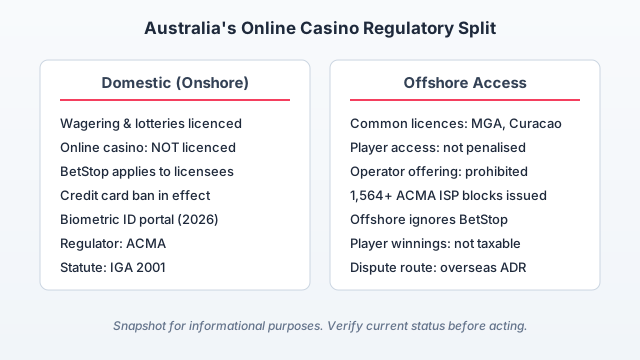
Getting the framing right removes half the confusion. Australia has a domestic wagering market — sports betting, race betting, lotteries and Keno — that is licensed at the state and territory level and supervised nationally under the same 2001 statute. It does not have a domestic online casino market. Every real-money online casino product you see marketed at Australian traffic is sitting on a Maltese, Curacao, Costa Rican or Panamanian licence.
Is it legal for me as an Australian to play at offshore casinos?
Yes for the player, no for the operator. The Interactive Gambling Act 2001 draws its criminal line at the supply side. It prohibits any person from providing an online casino service to a customer physically present in Australia, and it authorises the Australian Communications and Media Authority to enforce that prohibition against offshore providers. It does not create an offence for the individual customer who signs up, deposits, and plays. If you want the deep-dive version, our online casino australia FAQ unpacks the wording clause by clause.
This asymmetry is deliberate. The 2001 parliament decided to target the businesses offering the product, not the households paying for it. That framing survived the 2016-2017 amendments that added the ACMA blocking regime and the register of prohibited services. It survived the 2023 launch of BetStop and the 2024 credit card and crypto restrictions. As of 2026 there has been no serious legislative proposal to reverse the asymmetry and criminalise residents for playing at an offshore online casino australia site.
What "legal" does not mean is "safe", "regulated for you" or "backed by Australian consumer protection". None of those apply. If a Maltese-licensed operator freezes your withdrawal, ACMA cannot force a resolution; the enforceable route runs through the Malta Gaming Authority's dispute mechanism, not through any Australian body. That is why we spend so much of this page on verification and complaint routes.
Why doesn't Australia licence its own online casinos?
Two reasons, one political and one economic. The political reason is that the 2001 legislation reflected community concern about the harm profile of house-banked gaming delivered into the household — a concern that has hardened rather than softened over the last twenty-five years. The economic reason is that state and territory governments already draw substantial tax revenue from the domestic wagering channel, so there has been no strong pull from state treasuries to create a competing federal online casino australia licensing regime that would eat into pokies venue revenues.
Successive productivity commission inquiries and parliamentary reviews have canvassed alternative models — regulated domestic online pokies, harm-minimisation-first frameworks, tighter foreign enforcement — without producing a legislative appetite for change. Instead, the policy direction from 2017 onward has doubled down on enforcement of the existing prohibition: more blocking orders, more restrictions on payments and marketing, and more attention to affiliate content. The next section covers the statute driving that enforcement.
What is the IGA 2001 and how does it apply?
The Interactive Gambling Act 2001 is a short Commonwealth statute that does three things. First, it defines a "prohibited interactive gambling service" — essentially online casino products, in-play sports betting delivered online, and a handful of adjacent products. Second, it makes provision of that service to a customer in Australia a criminal offence for the provider. Third, it hands ACMA a civil enforcement toolkit including blocking orders directed at Australian internet service providers.
The practical operation is straightforward. ACMA receives complaints about offshore operators, investigates whether they are targeting Australian residents, and issues formal findings. Where the finding is that a service is offering a prohibited interactive gambling product, ACMA can request Australian ISPs to block the domain. Between November 2019 and mid-2026, ACMA has issued blocking requests against more than 1,564 sites. The tempo of blocks has increased through 2025 and 2026 as smaller operators and affiliate marketing pages have come into scope.
Nothing in the IGA speaks directly to the player. There is no offence, no penalty, no reporting obligation on the resident. That is why every credible legal explainer — including this one — separates "operator legality" from "player consequences" when discussing online casino australia access.
Which licence jurisdictions serve Australian players?
Four jurisdictions provide most of the offshore licences that end up in front of Australian search users:
- Malta (MGA). The gold-standard European licence. MGA licences carry segregated player-fund requirements, independent RNG audits, mandatory alternative dispute resolution and rigorous anti-money-laundering supervision. Not all MGA licensees accept Australian traffic, but a material subset does.
- Curacao (GCB). Historically the most common licence behind Australian-facing online casino australia brands. The Curacao regime has been reforming since late 2024 under the National Ordinance on Games of Chance, moving from master-licence sub-licensing to direct licensing by the Gaming Control Board.
- Costa Rica. Costa Rica does not licence gambling in the technical sense; operators registered as data-processing businesses have historically used the jurisdiction for hosting. Enforcement and consumer protection posture here is weakest of the four.
- Panama. A smaller player, with the Junta de Control de Juegos regulating a mixed onshore/offshore market. Panama licences appear on a modest share of Australian-facing operators.
The jurisdictional choice is a proxy for how much recourse you actually have if a dispute goes to arbitration. That is not a small point.
What's the difference between MGA and Curacao licences?
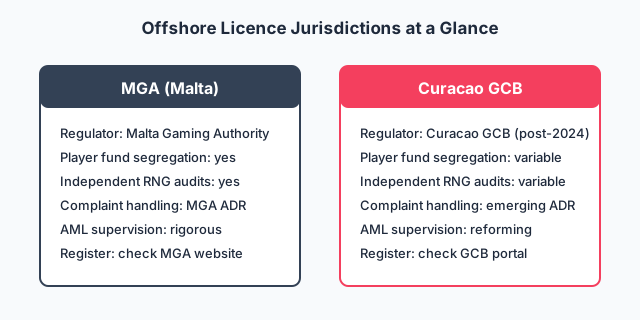
Six operational differences matter for a player. First, segregated player funds — MGA requires operator client money to be held apart from operating capital; Curacao's implementation has been patchier and is still being tightened under the 2024 reforms. Second, published RNG audit trails — MGA licensees typically publish independent testing houses; Curacao licensees vary widely. Third, complaint handling — MGA mandates an approved alternative dispute resolution route; Curacao is building an equivalent under the new GCB regime.
Fourth, transparency of the register — MGA's public register is fully searchable by licence number; the Curacao GCB portal became fully searchable in late 2025 and is still maturing. Fifth, AML supervision — MGA co-ordinates with EU AML directives; Curacao has committed to comparable standards but is a shorter track record. Sixth, ownership disclosure — MGA requires disclosure of ultimate beneficial owners; Curacao's disclosure regime has become stricter since 2024 but does not yet match MGA depth.
| Feature | MGA (Malta) | Curacao GCB |
|---|---|---|
| Player fund segregation | Mandatory | Reforming; verify per licence |
| Independent RNG audit | Standard, published | Variable, verify per operator |
| Alternative dispute resolution | Mandatory approved ADR | Emerging under 2024 reform |
| Public register lookup | Fully searchable | Fully searchable since late 2025 |
| Ultimate beneficial owner disclosure | Deep | Tightening under new regime |
| Track record for player disputes | Long, documented | Shorter, uneven |
None of that guarantees any particular player outcome. It changes the odds of a fair resolution when something goes wrong, and it changes how much documentation you should be keeping.
Do I pay tax on winnings from online casino australia play?
For the overwhelming majority of Australian players, no. The ATO's position is that ordinary gambling winnings are not assessable income because gambling is not treated as a business or vocation for individual taxpayers. That treatment has been consistent through decades of case law and public rulings. It applies to winnings from domestic wagering, lotteries and offshore online casino australia play alike.
The exception is the small population of players whose activity looks like a business. The ATO's hobby-versus-business test looks at whether the activity is organised in a businesslike way, whether it is carried on with an intention to profit, whether it is systematic, and whether the taxpayer relies on it as a livelihood. Meeting that threshold takes far more than a good year at the tables. Our online casino australia tax page walks through the ATO test in detail and gives worked examples.
Whichever category you fall into, keep records. Statements of transactions, screenshots of major wins, confirmations of withdrawals into an Australian bank account — none of these are legally required for a hobby player, but they answer the ATO's questions quickly if the ATO ever asks. Recordkeeping also matters for AUSTRAC context: large deposits landing back in an Australian account can trigger routine bank enquiries even where no tax liability arises.
Does BetStop apply to offshore online casino australia sites?
No. BetStop is the national self-exclusion register launched in August 2023 under the National Self-Exclusion Register Rules. It is administered by ACMA and applies to Australian-licensed wagering providers. Those providers must check the register before opening an account and are prohibited from taking bets from a registered person. Offshore online casino australia operators do not check the BetStop list. There is no international enforcement mechanism to compel them to.
The practical implication is that a self-excluded resident who signs up at an offshore casino will not be caught at the register-lookup stage. Some offshore operators run their own self-exclusion tools inside their platforms; those tools are only as reliable as the operator implementing them. Players who want a hard boundary treat BetStop as a starting point and layer additional measures — bank-level gambling blocks, device-level content restrictions, third-party blocking software — on top of it.
None of that changes the legal status of the register. BetStop is a real and useful tool for the domestic market. It is simply not a control that reaches into offshore infrastructure.
What are the credit card and crypto bans about?
Two separate rules, both introduced in 2024. The credit card ban prohibits Australian-licensed wagering providers from accepting credit card deposits from Australian residents. Its policy purpose is harm minimisation: the risk profile of gambling with borrowed money is markedly higher than gambling with money already in a transaction account. The rule applies at the operator side, meaning licensed wagering providers must decline credit card funding attempts.
The cryptocurrency measure applies similarly to Australian-licensed operators, restricting the use of crypto rails for gambling deposits on the domestic side. Both rules leave offshore operators untouched in a direct sense — an offshore online casino australia site is by definition not licensed here — but their downstream effect on Australian card issuers and payment processors has been real. Some Australian banks have expanded gambling-related merchant category blocks that cover credit and, in some cases, debit transactions to identified gambling merchants.
What this looks like from a player's chair is a growing list of "declined" or "cannot process" messages when trying to deposit to offshore casinos with everyday Australian payment tools. The picture is not uniform — some cards process, some do not, some do intermittently — and it shifts as banks adjust their risk rules through 2026.
How do I verify that an online casino australia operator is legitimate?
Legitimacy is a licensing question. Here is the step sequence, in the order that produces the best signal:
- Read the licence number from the operator's footer or "About" page. Any legitimate licensee shows this clearly; an operator that hides its licence number is a red flag before you look further.
- Copy the licence number and search it on the issuing regulator's public register. MGA and Curacao GCB both publish searchable registers. Confirm that the register entry exists and matches the operator's brand.
- Check that the licensed legal entity on the register is the same entity you are contracting with in the operator's terms and conditions. A licence in one company's name behind a website operated by a different company is not verification.
- Look for published independent testing certificates — RNG and payout audits from eCOGRA, iTech Labs, GLI or comparable bodies. These are optional at Curacao and mandatory at MGA.
- Search the operator on complaint aggregators to see whether payout disputes cluster. Old complaints can be misleading; recurring recent complaints on the same theme are informative.
Three of those steps are free and take a couple of minutes. If any single step fails, treat the licence as unverified and treat every deposit as risk capital you are prepared to write off. Rachel's rule at EP Info is that unverified licences never move to a deposit test.
What payment methods actually work for Australian players?
Availability shifts. As of mid-2026 the practical picture is roughly this: some Visa and Mastercard debit transactions succeed with offshore casinos, some are declined at the issuer, and some are declined at the operator. Prepaid vouchers work at a modest set of operators. E-wallets with global coverage — Neteller, Skrill, EcoPayz and similar — remain the most reliable rails where the operator supports them. Direct bank transfer via POLi has been effectively defunct since POLi wound down; equivalent local rails have partially filled that gap.
Cryptocurrency deposits work at operators that accept them, though the walls between crypto exchanges and Australian bank accounts have tightened through 2025 and 2026. Some Australian exchanges apply enhanced monitoring on outbound transactions to gambling-associated wallets. That is separate from the credit-card and crypto rules that bind domestic-licensed operators, but it produces friction at the payment step for anyone routing money to an offshore casino via crypto.
The compact takeaway is that no single payment method is uniformly reliable. Operators publish payment tables that go out of date; the empirical way to test is a small deposit and matching test withdrawal before committing serious money.
How long do withdrawals typically take?
Published windows and observed windows are different. Published windows commonly look like:
| Method | Published range | Observed in practice |
|---|---|---|
| E-wallet | 0–24 hours | Same day common; up to 3 days if KYC pending |
| Bank transfer (SWIFT) | 3–7 business days | 5–10 business days more realistic including intermediary banks |
| Card refund | 2–5 business days | Longer where card issuers block gambling merchant category codes |
| Cryptocurrency | Minutes to hours | Broadly aligned; network fees and confirmations add variance |
The other variable is KYC. If an operator has not yet verified your identity, address and payment ownership, the first withdrawal typically triggers full KYC before payout. That process runs 24 to 72 hours at well-run operators and can stretch to a week at slower ones. Doing full KYC pre-emptively, right after signup, is the single most effective way to shorten withdrawal time. Our new online casino australia coverage tracks how KYC expectations are evolving through 2026.
What if something goes wrong — what are my options?
Escalate in the following order. The point of the order is to keep the highest-value evidence intact and to give the operator the chance to resolve the issue before you take it public.
- Open a support ticket through the operator's own channels. Log the ticket number and take screenshots of every response.
- Escalate to the operator's compliance or player-protection team, usually via a distinct email address published in the terms.
- File a formal complaint with the licensing regulator. MGA's player support form is the fastest route for Maltese licensees; Curacao's GCB accepts complaints through its portal.
- Where an approved ADR body is in scope — this is standard for MGA licensees — file with the ADR. The ADR decision is binding on the operator.
- Consider a formal report to your Australian bank if a payment was mishandled. Bank chargeback windows are short, so this step is time-sensitive.
Two things not to do. Do not post confidential account details on public complaint sites while an active complaint is running — it usually complicates rather than accelerates a resolution. And do not close the account before the withdrawal has cleared, because closed accounts are harder to reopen for evidentiary follow-up.
Frequently Asked Questions
Is playing online casino australia illegal for me as a resident?
No. The Interactive Gambling Act 2001 targets operators offering the service, not the individual player accessing it. Individual Australians are not prosecuted for playing at offshore casinos.
Does BetStop apply to offshore online casino australia sites?
No. BetStop is the domestic self-exclusion register, and it only binds Australian-licensed operators. Offshore casinos do not check the BetStop list.
Do I pay tax on winnings from online casino australia play?
For nearly all individual players, no. The ATO treats gambling as a hobby rather than assessable income, unless the play is organised, systematic and profit-driven at a business level.
What is the IGA 2001 in plain English?
The Interactive Gambling Act 2001 is the federal statute that prohibits operators from providing online casino services to Australian residents. It is a supply-side prohibition, not a demand-side one.
How can I tell if an operator's licence is real?
Read the licence number from the footer, search it on the issuing regulator's public register, and confirm the operator's legal entity matches the register entry. If any of those steps fails, treat the licence as unverified.
How long do withdrawals usually take at online casino australia sites?
Typical published windows are 24 to 72 hours for e-wallets, three to seven business days for bank transfers, and near-instant to a few hours for approved crypto rails on operators that still support them for offshore players.
What's the difference between MGA and Curacao licences?
MGA is a European regulator with segregated player funds, mandatory ADR and rigorous AML supervision. Curacao GCB is the Caribbean regulator that has been reforming since 2024 toward stricter oversight, but historical enforcement was lighter.
Responsible Gambling
Gambling stops being entertainment when it starts costing you something you cannot afford — money, sleep, relationships, work. If you are noticing any of those, treat that as the signal to step back. Set deposit limits before you play, not after. Keep session times short. Never chase losses. If you are self-excluded, the offshore path is the wrong path — the domestic BetStop register is the enforceable one.
Support in Australia is confidential and free. Gamblers Help provides state-based counselling. GambleAware runs national awareness programs. Lifeline offers 24/7 crisis support on 13 11 14. Talking to another human is the single highest-leverage step at any point in the harm cycle. For statutory context on the framework this page discusses, the Interactive Gambling Act 2001 is available in full on the federal register, and Wikipedia's Gambling in Australia article gives a policy overview.
Our dedicated responsible gambling page lists the tools we recommend and the questions we think are worth asking yourself before you deposit again.