
Market developments 2025 to 2026
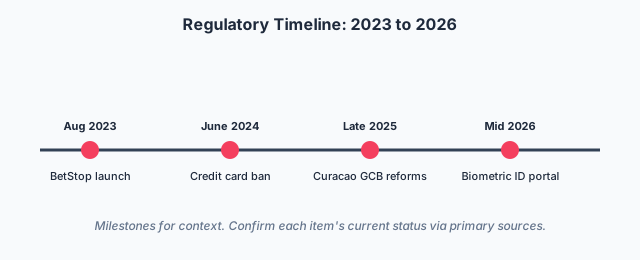
The market for online casino australia access has been reshaped by three separate strands over the last eighteen months, and it is worth setting them out at the top so the sections that follow can be read against a common backdrop. Strand one is the Curacao licensing reform, which shifted the regime from master-licence sub-licensing to direct GCB licensing. Strand two is the domestic biometric ID portal, which began pilot rollout in mid-2026 for Australian-licensed operators. Strand three is the tightening of Australian bank-side controls on gambling-related outbound payments.
None of the three is isolated. The Curacao reform has pushed some existing licensees to relocate to MGA or to new Curacao direct licences; the biometric portal is being watched carefully by offshore operators as a possible template for future domestic policy; and the bank-side friction has quietly changed which payment rails work in practice. Any Australian resident evaluating a "new" casino site in 2026 is really evaluating the intersection of these three strands.
ACMA blocking activity has continued in the background. As of mid-2026 the running total stands above 1,564 blocked sites since the November 2019 baseline, with enforcement tempo picking up through 2025 and 2026 against smaller operators and affiliate networks. New brands launching into Australian-facing traffic are aware of the block risk and increasingly try to reduce visibility to ACMA — often by trading domains, by segmenting Australian-facing content behind sign-in walls, or by moving marketing energy to less-visible channels.
New operators appearing on European licences
A visible shift in the last twelve months is that a larger share of new Australian-facing operators are launching on MGA licences rather than on legacy Curacao sub-licences. This is partly a signal effect — an MGA licence looks better to players comparing options — and partly a compliance effect, as some operators have concluded that the reformed Curacao regime's compliance burden is now close enough to MGA that the marketing advantage of MGA justifies the choice.
New Curacao GCB direct licensees are also a growing cohort. The GCB began issuing direct licences in earnest through 2024 and 2025, and by mid-2026 a material set of Australian-facing brands are operating under those new licence numbers rather than under legacy sub-licences from the pre-reform era. The two categories look similar from the player side but represent different legal postures, and the GCB register distinguishes them clearly.
New payment methods in the Australian context
Payment options have shifted in two directions at once. Offshore casinos have expanded the crypto side — Bitcoin, Litecoin, Ethereum and increasingly USDT and USDC — as their default default-currency rails. Prepaid vouchers and cards have picked up a modest share where they can be funded from an Australian card. Domestic bank rails, meanwhile, have contracted: more Australian banks have added gambling-related merchant-category blocks that catch a growing share of card transactions to offshore operators.
- Stablecoins: USDT and USDC accounts insulate both sides from crypto price volatility while retaining the operational advantages of on-chain settlement.
- Prepaid vouchers: Paysafecard-style options remain useful where the operator supports them.
- E-wallets: Skrill and Neteller continue to be the fastest rails at operators that accept them.
- Debit cards: Availability has become intermittent as Australian banks tighten gambling-related merchant blocks.
- Bank transfer: Slower but still functional; POLi-style local instant rails are effectively unavailable since POLi wound down.
The compact takeaway is that no single method is uniformly reliable in 2026. Empirical testing with a small deposit and matching test withdrawal is more informative than any operator's published payment table.
Two payment-adjacent developments matter beyond the rails themselves. First, some Australian banks have moved from blocking a specific set of merchant codes to using algorithmic detection of gambling-adjacent transaction patterns, which has caught legitimate non-gambling payments in a small share of cases. Second, buy-now-pay-later products are being watched by regulators as a potential funding source for gambling, and expect additional restrictions in that space through 2026.
Evolution of KYC requirements
KYC has become more thorough at both the MGA and reformed Curacao levels. Selfie verification is now standard rather than optional at most operators. Proof-of-source-of-funds requests appear earlier in the customer lifecycle, often at first significant withdrawal rather than at some later enhanced-due-diligence trigger. Payment-ownership verification — matching the payment method to the account holder — is stricter.
- Government photo ID scan (passport or driver licence).
- Address verification (utility bill or bank statement, usually under three months old).
- Selfie or short liveness video matching the ID document.
- Payment-ownership evidence (bank statement or card image with account holder visible).
- Source-of-funds documentation for higher deposits (pay slip, savings statement, or explanation letter).
Doing all five pre-emptively at signup removes the friction from the first withdrawal. It is a fifteen-minute exercise that saves 24 to 72 hours later. Rachel's rule at EP Info is that any signup that stalls at KYC without a clear reason is a signup worth walking away from.
How bonus rules have evolved
Wagering multiples have crept up slightly across the market in 2025 and 2026, especially on match bonuses tied to first deposits. Where 30x to 40x on bonus was normal in 2024, 40x to 60x on bonus is now more common, with a persistent minority of operators using deposit-plus-bonus as the base. Game weightings have not changed materially — pokies at 100 per cent, table games at 10 per cent or zero, live casino often at zero — but the market has become more careful about publishing the weightings clearly rather than burying them in general terms.
| Term | 2024 typical | Mid-2026 typical |
|---|---|---|
| Match percentage | 100–200% | 100–200% |
| Wagering multiple | 30–40x bonus | 40–60x bonus |
| Expiry window | 7–14 days | 14–30 days |
| Maximum bet during bonus | AUD 5 | AUD 5 |
| Irregular-play clause | Present but vague | Present and specific |
The tightening of irregular-play clauses is the change that has caused most of the recent player complaints — clauses now specify prohibited patterns (edge betting on high-volatility games with matched-play sizing, for example) more precisely, which cuts both ways. Players who read the clause carefully know what to avoid. Players who skim it are more likely to trip it and have a bonus voided.
Dispute-resolution developments
The most significant dispute-resolution change is the maturation of the Curacao GCB player complaint route. Complaints filed through the GCB's portal are now processed on a published timeline, with the reformed system committing to initial response within a defined window and to substantive resolution within a further defined window. The old master-licence system had no comparable timeline; complaints under it could sit indefinitely.
MGA's approved ADR route is unchanged in substance. It remains the fastest binding route in the market, with ADR decisions typically issued within weeks rather than months. The list of approved ADR bodies has expanded slightly through 2025.
What has not changed is that Australian consumer law does not fully cross into an offshore contract. There is no Australian tribunal or ombudsman with jurisdiction over an offshore casino payout dispute. That remains a structural feature of the offshore market, not a policy oversight.
Digital trends worth tracking
Three digital trends matter for the coming twelve months. First, live dealer studios have expanded their catalogue and reduced the entry stake at popular tables, which has increased live casino share of overall session time. Second, provably-fair game architectures have moved from crypto casino niche into a modest number of mainstream operators, offering cryptographic verification of RNG outcomes for players who care to check.
Third, AI-driven customer service is now the default at most offshore operators for first-line support. That has cut response times materially but introduced a new class of complaint where the AI has answered a specific query incorrectly and the resulting misunderstanding takes longer to resolve than the original ticket would have. Keeping screenshots of AI chat responses matters more than it did a year ago.
None of these trends is a game-changer on its own. All three are worth noticing because they change the shape of what a "typical" 2026 operator looks like relative to a 2024 baseline.
A fourth trend worth flagging is the increasing use of behavioural analytics for early harm detection at MGA licensees. Operators are being asked by their regulator to detect distress patterns — rapid deposit escalation, session-time creep, chase behaviour — and to intervene proactively. Whether this results in a meaningfully different player experience will be visible over the next year, but the direction of travel is clear.
New Australian interpretations of EU-licensed casinos
The Australian regulatory posture toward EU-licensed casinos accepting Australian residents has not softened. ACMA continues to treat an MGA-licensed operator serving Australian traffic exactly the same as a Curacao-licensed one for blocking purposes — the licence category is not a defence. What has shifted is the market perception. EU-licensed operators are increasingly viewed by Australian search users as materially more reliable than legacy Curacao operators, and the search traffic to those brands reflects that perception.
Legally, none of that matters. The IGA does not distinguish between EU and Caribbean licences. Practically, all of it matters. The operators most exposed to ACMA blocking are the ones with the shakiest player-protection record, because they are also the ones most reliant on unrestrained Australian advertising, and that unrestrained advertising is what puts them in ACMA's line of sight in the first place.
A related market shift is that Australian search engine results have been quietly reshaped by the block list. Domains that appear in the ACMA blocked list drop rapidly from Australian search results, and affiliate sites that link to them see traffic drops. This has pushed some new operators to invest more in organic community building — Reddit threads, Discord servers, forum sponsorships — rather than in traditional affiliate marketing. That shift changes the surface area a curious player interacts with, and it changes where you can look for user experience reports that are not directly commissioned by the operator.
Expectations for 2027
Three watch points for 2027. First, bank-side controls on gambling-related outbound payments are likely to expand further as Australian banks respond to prudential and reputational pressure. Second, the Curacao GCB complaint route will complete its maturation phase, with a track record of published decisions and enforcement actions that will let players evaluate its practical value objectively for the first time.
Third, the biometric ID portal — currently a domestic-only measure — will run through its pilot phase and will be evaluated politically. If the pilot is judged successful, downstream policy conversations may include offshore-relevant elements, though there is no current proposal to extend biometric verification to offshore access. Any Australian domestic policy conversation on that topic would be at least a two-year process to legislate and implement.
None of the above changes the baseline analysis on this page. The IGA remains the operative statute, the operator side remains prohibited, the player side remains unpenalised, and the offshore market remains the practical channel for Australian residents seeking online casino products. Our online casino australia FAQ covers the baseline in more detail if you want a refresher.
Frequently Asked Questions
What has changed most for new online casino australia access in 2026?
Three things: the reformed Curacao GCB direct-licensing regime is now the dominant framework for new operators, the domestic biometric ID portal has entered pilot rollout, and Australian bank restrictions on gambling-related outbound payments have expanded materially.
Are new operators mostly on European licences now?
A larger share than before. New Australian-facing operators launching in 2025-2026 are more likely to appear on MGA or the new Curacao GCB direct licence rather than legacy sub-licences under the old Curacao master-licence system.
Have new payment methods emerged that work in Australia?
Yes and no. Stablecoin rails have become more common at offshore casinos, and some voucher and prepaid card options have expanded. Domestic bank rails have gone the other way, with more restrictions and merchant-category blocks.
How has KYC changed for offshore operators serving Australians?
KYC is applied earlier and more thoroughly, driven by tightening AML supervision at MGA and the reformed Curacao GCB. Selfie verification, proof-of-source-of-funds, and payment ownership verification are more common than they were two years ago.
Have bonus terms changed?
Wagering multiples have crept up slightly, and irregular-play clauses have become more standardised. The competitive market has responded by lengthening the expiry windows on some flagship bonuses.
Is dispute resolution getting better or worse?
Better in Curacao under the new direct-licensing regime, stable in Malta, and unchanged elsewhere. The direction of travel is positive but not fast.
What should Australian players watch through 2027?
Bank-side controls on offshore gambling outflows, the maturation of the Curacao GCB complaint process, and any parliamentary movement on domestic online casino licensing (currently not on the political agenda but periodically reviewed).
Responsible Gambling
A new operator is not automatically a safer operator. If anything, brand-new operators carry more risk because their complaint track record is unbuilt. Deposit conservatively into a new brand, complete KYC pre-emptively, and treat the first withdrawal as a test rather than a large payout. Set deposit and session limits from the first login rather than the first loss.
Confidential Australian support runs around the clock through Lifeline on 13 11 14 and through Gamblers Help. For legal and policy background, the Interactive Gambling Act 2001 is the operative statute, Wikipedia's Gambling in Australia article is a policy backgrounder, and the OECD's regulatory policy work gives comparative context. Our responsible gambling page lists the practical tools we recommend.