
The Australian tax rule on gambling winnings
The starting point for online casino australia tax analysis is a rule the ATO has held consistently for decades: ordinary gambling winnings are not assessable income for individual taxpayers. That treatment rests on a chain of case law running back to the mid-twentieth century and is reflected in current ATO public rulings and guidance. The rule applies whether you win at the local RSL, from a domestic-licensed wagering operator, or from an offshore casino accepting Australian residents.
The mirror-image consequence is that gambling losses are not deductible either. You cannot claim your net losses against wage income, and you cannot claim gambling expenses (chip costs, subscription fees, travel to a venue) against gambling winnings. The whole activity sits outside the assessable-income and allowable-deduction framework in the ordinary case.
This is the compact position and it is stable. The exceptions are narrow — professional gamblers who cross into carrying on a business, and any taxpayer for whom the winnings are more accurately characterised as compensation, prizes for services, or trading profits under a different legal characterisation. Those cases are unusual and involve facts most casual players will never face.
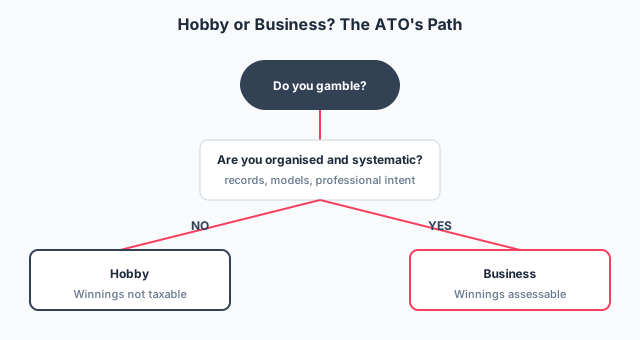
The ATO's hobby-versus-business distinction
The ATO analyses whether gambling constitutes a business by applying the general "carrying on a business" test that applies to any activity. The core factors are: is the activity organised in a businesslike way; is there a profit-making intention; is the activity systematic and repeated; is it commercial in scale relative to the taxpayer's other activities; and does the taxpayer rely on it as a source of livelihood.
Each factor is weighed together with the others. No single factor is decisive. Meeting one factor — say, playing systematically — is not enough on its own to convert a hobby into a business. The ATO's public rulings on this point emphasise that gambling requires an unusually strong combination of factors before it will be treated as a business, precisely because chance dominates the outcome for most gambling activities. Where chance dominates outcome, the ATO reasons, the activity is genuinely different from operating a trade or profession.
The edge cases matter because they exist. Poker professionals, for example, sometimes cross into business treatment where the game skill component and their commercial organisation together outweigh the chance component. That is a fact-specific analysis and needs professional tax advice before relying on it either way.
Do foreign winnings change anything?
For the tax outcome, no. Australian residents are taxed on worldwide income, but "winnings" that are not assessable income domestically remain non-assessable when sourced offshore. The ATO's hobby-versus-business analysis applies to the character of the activity, not the geographic source of the winnings. A hobby gambler winning at an offshore casino faces the same tax outcome as a hobby gambler winning at a local pub: no assessable income.
Two ancillary considerations do change with foreign winnings. First, foreign exchange gains and losses can arise if funds are held in a foreign currency and converted back to Australian dollars at a different rate. For a small player these gains are negligible; for a player rolling material sums through offshore accounts they can matter and are separately assessable under Division 775 of the Income Tax Assessment Act 1997. Second, AUSTRAC reporting is triggered by threshold transactions regardless of the underlying activity — a bank receiving a large offshore transfer will report it, and the taxpayer may be asked to explain the source.
Neither of those creates income tax on the winnings themselves. They create a paperwork trail that a hobby gambler can easily satisfy with the same evidence any careful record-keeper would already have on hand.
What counts as "carrying on a business" of gambling?
The ATO looks at a bundle of factors together. A useful mental shorthand is to imagine describing the activity to a friend without using the word "gambling":
- Are you organised — spreadsheets, models, session logs, staking plans?
- Is there a profit-making intention that is more than optimistic hope?
- Is it systematic — planned session structure, planned bankroll allocation, planned exit points?
- Is it repeated with a discernible pattern?
- Is it commercial in scale relative to your other financial activity?
- Do you rely on it as a livelihood, in whole or in part?
- Have you invested materially in equipment, software, or professional training?
Meeting most of these together is the threshold. Meeting one or two is not. This is why the ordinary punter, who bets casually and irregularly on games where luck dominates, cannot be reclassified into a business posture simply by having a good year. The ATO's own guidance is candid on this point: it takes a lot of evidence to displace the presumption that gambling is a hobby.
Record-keeping expectations for casual players
Legally, casual players are not required to keep gambling records for tax purposes. The winnings are not assessable, so the ATO has no direct interest in the underlying transactions. Practically, keeping records anyway is worth doing for a different reason: they answer bank enquiries and payment questions much faster than reconstructing the picture from memory.
- Keep operator statements as PDFs when you close a session — most operators offer a monthly download.
- Screenshot significant wins with the timestamp and account balance visible.
- Match withdrawals to bank deposits in your own transaction log.
- Note the FX rate on any deposit and matching withdrawal for the same money in and out.
- Keep KYC document scans in a secure location — you may need to reproduce them later.
Total effort is a few minutes per session and it removes almost all of the potential friction if a bank ever asks. Whether the ATO asks separately is uncommon; whether a bank asks about a large deposit is routine, and answering that quickly with records is a very good idea.
What documentation to hold and for how long
Australian tax record-keeping obligations are generally five years from the relevant lodgment. For hobby gamblers there is nothing to lodge in respect of winnings, so the strict five-year rule does not attach. A more useful rule of thumb is to keep three tax years of gambling records at any time, aligned with the ATO's general audit-window practice.
| Document | Why | Hold period |
|---|---|---|
| Monthly operator statement | Establishes source of deposits and withdrawals | 3 years |
| Bank statement matching operator withdrawal | Answers bank source-of-funds enquiries | 3 years |
| KYC document scans | May be needed for reverification with any operator | Current |
| Screenshots of large wins | Evidence if an operator disputes a payout | Until settled |
| Correspondence with support / compliance | Evidence trail for any complaint | Until settled |
The picture is simpler than tax record-keeping for a small business. It is closer to the paperwork trail you would keep for a hobby that generates occasional insurance-relevant events — enough to reconstruct what happened, not the whole business ledger.
When the ATO might ask questions
ATO enquiries about gambling-related funds are uncommon at the individual level and typically arise indirectly. The most common trigger is a data-matching exception — funds landing in an Australian account that do not match reported income and that pattern-match to a category the ATO has flagged. In those cases the ATO writes and asks for a short explanation with supporting documents.
The correct response is to explain the source (gambling winnings) and provide records: the operator statement showing the withdrawal, the bank statement showing the corresponding deposit, and any FX confirmation. In the vast majority of cases the enquiry is closed once the documents match. This is the whole reason to keep the records described above — not because there is a tax liability, but because the enquiry cycle is fastest when documents are ready.
Where things get more complicated is when the pattern of activity itself resembles carrying on a business — very frequent sessions, professional-scale bankrolls, or reliance on gambling for cost-of-living funding without other reported income. In that scenario the ATO's analysis moves toward business treatment, and a professional tax advice conversation becomes necessary rather than optional.
Difference from wagering and sports betting
The Australian tax treatment of individual sports betting winnings is the same as for online casino winnings: hobby versus business, and hobby wins. What differs is the surrounding regulatory context. Sports and race betting are licensed domestically at the state level; operators withhold state-level gambling taxes and remit them to state revenue offices. None of that changes the individual player's income tax position.
The difference that matters for many players is the record trail. Domestic-licensed wagering providers submit routine reporting to state revenue offices. Offshore casinos do not report to Australian revenue authorities at all. That means an offshore casino's records live only with the operator and with you. Losing access to those records — through account closure, operator failure or licence surrender — makes it harder to answer any later enquiry. That is the strongest single reason to keep your own downloaded copies as you go.
Professional punters can be assessed as running a business, but the threshold is high. Case law involving professional punting rests on a combination of skill, system and organisation that ordinary sports betting never approaches. A hobbyist punter placing weekend bets on the AFL, even with sustained luck across a season, does not cross that line simply by winning consistently. The character of the activity has to change materially, not just the balance in the account.
A concrete worked example
Take a hypothetical player, Maya, in Adelaide. Maya works as an IT consultant and plays occasionally at an offshore casino licensed by the MGA. Over the 2025-26 tax year she deposits AUD 6,000 across the year, withdraws AUD 4,200 back to her bank account, and holds AUD 900 as an open balance at year end. Her cumulative loss for the year is AUD 900. She wins one large hand of AUD 2,800 in December.
- Is any of the AUD 4,200 in withdrawals assessable? No. It is gambling winnings from a hobby activity.
- Is the AUD 2,800 win assessable? No. It is a single winning event within the same hobby.
- Is the AUD 900 loss deductible? No. Gambling losses of a hobby are not deductible.
- Does her bank potentially ask about the AUD 2,800 withdrawal? Possibly, if the transaction pattern is unusual for her account. She answers with the operator statement.
- Does the ATO potentially ask? Rarely at this scale. If asked, she answers with the same operator statement and her matching bank record.
Maya's tax return for the year is unaffected by the gambling activity in every direction. Her ordinary income from her IT work is reported and taxed as normal; her gambling activity does not appear anywhere on the return. If Maya's activity grew to full-time proportions with material bankroll, systematic staking and reliance on the income, that analysis would change and she would need advice from a tax practitioner before the next return.
For most Australian readers of this page, Maya's numbers are conservative relative to their own. That is the intended point of the example. Our new online casino australia coverage tracks how tax adjacent reporting expectations are evolving through 2026 alongside the biometric ID portal rollout.
Frequently Asked Questions
Do I pay income tax on my online casino winnings?
For nearly all individual Australian players, no. The ATO treats gambling as a hobby and does not assess winnings unless the activity is carried on as a business.
Does the source jurisdiction matter for tax?
For the tax outcome, no. Whether the winnings come from an Australian venue, a domestic-licensed wagering operator, or an offshore casino, the ATO applies the same hobby-versus-business analysis.
What is the ATO's hobby versus business test?
The ATO looks at organisation, system, intention to profit, and reliance on the activity as a livelihood. Meeting the threshold requires most of these factors together, not just one or two.
What records should I keep as a casual player?
There is no statutory record-keeping obligation for hobby gamblers, but transaction statements, screenshots of significant wins, and matching bank records make ATO or bank enquiries painless.
When might the ATO ask questions?
When incoming funds do not match reported income, or when patterns look like a business. Enquiries are usually resolved by producing records showing that the amounts are gambling winnings.
Is tax treatment different for sports betting?
The same principles apply — hobby versus business — with the same practical outcome for the ordinary punter. Professional punters may be assessed as running a business.
What about GST on gambling?
GST applies to gambling supplies at the operator level, not at the player level. Individual players do not remit GST on their winnings or their play.
Responsible Gambling
Tax treatment is not a green light. A hobby that is not taxed is still a hobby that can cost you money, sleep, and relationships. Set deposit and session limits before you play. Track your net position honestly. If the honest number surprises you in either direction — much bigger losses than expected or a run of wins that has changed your relationship to the activity — treat that as a moment to pause.
Confidential Australian support is available around the clock through Lifeline on 13 11 14 and through Gamblers Help state services. Wikipedia's overview of gambling in Australia is a useful policy backgrounder, and the full text of the Interactive Gambling Act 2001 lives on the federal register. Our responsible gambling page collects the practical tools we recommend.