
What "online casino australia" means in practice
Read literally, online casino australia should describe a casino licensed under Australian federal or state law and operating over the internet. In practice, no such licence category exists. The Interactive Gambling Act 2001 explicitly prohibits any operator from offering online casino services to a customer physically in Australia. So "online casino australia" is a search shorthand for offshore-licensed casinos that accept Australian resident sign-ups.
That is the definition the rest of this FAQ uses. When someone in Adelaide or Perth asks whether an "online casino australia" is safe, what they are really asking is whether a Maltese-licensed or Curacao-licensed operator that accepts Australian traffic is safe. The answer depends on the licence, the operator, and the specific transaction — not on any Australian licensing framework, because none is issued for these products.
Two consequences flow from that framing. First, Australian consumer law protection does not extend fully into an offshore contract, so player recourse is jurisdictionally split. Second, the marketing you see on Australian-facing casino sites is not regulated by the same rules that apply to a domestic wagering brand — no ACMA advertising codes, no domestic promotion licensing, no capital-adequacy oversight. Every remaining question on this page unpacks a corner of those two consequences.
Who oversees offshore operators serving Australians?
The regulator that issued the operator's licence. If the licence is Maltese, it is the Malta Gaming Authority. If it is Curacao, it is now the Gaming Control Board under the 2024 reforms. If Costa Rica, effectively no regulator in the meaningful sense — the country does not licence gambling; it hosts data-processing entities. If Panama, the Junta de Control de Juegos.
ACMA has no direct authority over any offshore regulator or operator. Its jurisdiction is Australian ISPs and Australian-facing conduct. When an offshore operator ignores an ACMA finding, ACMA cannot fine it or arrest anyone inside its corporate structure. What it can do is compel Australian internet providers to block the domain, and it has done so more than 1,564 times since November 2019.
That is why licensing jurisdiction is not academic. It determines whose written rules the operator must follow, whose register you can search, and whose complaint mechanism you can rely on when things go wrong. In descending order of practical player protection: MGA, the reformed Curacao GCB, Panama JCJ, and Costa Rica (which is effectively unregulated for player-protection purposes).
The oversight picture also determines how much of the operator's public-facing content you can trust. MGA licensees are constrained by advertising codes that limit misleading claims and require prominent responsible-gambling messaging. Curacao's advertising controls have been lighter historically and are tightening under the 2024 reforms. Costa Rica applies effectively none. If an Australian-facing site is running claims that would not be legal on a domestic wagering ad, that is a signal about the licence category rather than a signal about the specific claim.
Are offshore casinos illegal in Australia?
The operator side is illegal; the player side is not. Section 15 of the IGA 2001 makes it an offence to provide an interactive gambling service to a customer in Australia. Section 15A creates the corresponding civil penalty. Neither section attaches liability to the customer. There has been no reported prosecution of an individual Australian resident for playing at an offshore casino under the IGA.
What is illegal for the operator is not the same as what is enforceable against the operator. Because these companies sit outside Australia, prosecuting them in Australian courts is impractical. That is why the enforcement regime added in 2017 was designed around ISP blocking rather than direct prosecution — blocking works against a domain visible in Australia; prosecution does not work against a shell company in the Caribbean.
MGA vs Curacao — the real difference
The stylised difference between MGA and Curacao licences is enforceability and disclosure. MGA has a long, public track record of enforcing against licensees who mishandle player funds or fail to honour ADR decisions. Curacao's enforcement track record has been thin historically and is still building under the 2024 GCB direct-licensing regime. That is the real difference, not the presence or absence of the licence itself.
| Feature | MGA | Curacao GCB |
|---|---|---|
| Track record of penalising licensees who mishandle funds | Long, documented | Short, building |
| Public register searchable by licence number | Yes, longstanding | Yes, since late 2025 |
| Mandatory approved ADR body | Yes | Emerging |
What that looks like on the ground: a MGA-licensed operator that refuses to pay out a withdrawal will face a MGA-approved ADR that produces a binding decision inside weeks. A Curacao-licensed operator in the same situation will face a GCB complaint that produces an outcome inside months, depending on which of the reformed licence categories the operator holds. Neither guarantees payment; both change the odds.
What languages are commonly supported?
English is universal because the offshore operator base is largely built for English-speaking markets. Beyond English, most Australian-facing operators support European first languages — German, Spanish, Italian, French, Portuguese — because those are the primary populations of the operator's other markets. Some add Japanese, Korean and Portuguese variants for East Asian and Latin American traffic.
Language coverage rarely matters for legal recourse. Terms and conditions are almost always governed by an English version, with translations offered as convenience only. If an operator lists a fifty-language interface and only offers English terms, the English terms are the ones that will decide any dispute. That is standard offshore casino contract drafting and it is worth noticing before you sign up.
Practical implication: if English is not your first language and you are relying on translated terms, the safe assumption is that the English version prevails. Read the English terms once end to end. It is dry work but it is the highest-value fifteen minutes you will spend on the whole registration process.
What currencies are commonly accepted?
AUD is offered at operators that formally market to Australian traffic. EUR and USD are the defaults on operators that accept Australian residents silently. A minority of operators offer NZD as well. Currency exchange fees apply whenever your deposit currency differs from the operator's account currency; those fees eat 1.5 to 3 per cent on typical debit-card transactions and are worth pricing in before choosing an operator.
Cryptocurrency-denominated accounts are increasingly common at offshore casinos, with Bitcoin, Litecoin and stablecoins the most-supported tokens. Deposits and withdrawals in crypto sidestep the currency conversion issue on the operator side, but they still create an on-and-off ramp friction between your Australian bank account and the exchange. That friction has been growing through 2025 and 2026 as Australian exchanges implement enhanced monitoring on gambling-related outflows.
The practical rule of thumb is simple. Where AUD is available and the operator is otherwise trustworthy, use AUD. Where AUD is not available, price the FX cost into your session budget explicitly, and use the same currency for deposit and withdrawal to avoid double-conversion.
A note on stablecoins. USDT and USDC accounts have become common at offshore casinos over the last two years because they insulate both sides from crypto price volatility. They do not insulate you from the on- and off-ramp friction between Australian dollars and the stablecoin — that step still runs through an exchange or peer-to-peer route, both of which have their own compliance overheads and, at some Australian exchanges, gambling-related outbound restrictions.
Typical withdrawal times
Withdrawal times are shaped by three variables: the operator's internal processing queue, KYC completion status, and the payment rail's own settlement window. All three need to align for a withdrawal to hit your bank account on schedule.
- E-wallets: 0–24 hours at well-run operators once KYC is complete. Skrill and Neteller are the fastest rails in practice.
- Bank transfers: 3–7 business days published, 5–10 business days end to end after intermediary bank routing.
- Card refund: 2–5 business days, subject to Australian card issuer's gambling merchant category treatment.
- Cryptocurrency: minutes to hours from operator to wallet, then a separate lag through any exchange back to AUD.
Complete KYC pre-emptively at signup. That single decision removes the 24-to-72-hour KYC lag from your first withdrawal and pays back time throughout the account lifetime. Have a passport or driver licence scan, a utility bill or bank statement showing address, and a payment-ownership document ready before you start.
Typical bonus terms and what to check
Match bonuses of 100 to 200 per cent are the market norm. Wagering requirements typically fall between 30 and 60 times the bonus, sometimes 30 to 60 times the deposit plus bonus (which is materially harder to clear). Game weightings determine how quickly you accumulate wagering: pokies typically count 100 per cent, table games often count 10 per cent or zero, and live casino often counts zero for wagering purposes.
- Read the wagering multiple — 30x is manageable; 60x on deposit plus bonus is very hard.
- Check the game weightings — a "great bonus" that excludes table games is not a great bonus if you play blackjack.
- Check the maximum bet while a bonus is active. Breaching it voids the bonus.
- Check the expiry window. Anything under seven days is aggressive; thirty days is generous.
- Check the maximum cashable amount. Some bonuses cap the withdrawable balance at a multiple of the deposit.
The compact version: treat every bonus as an offer with strings. Read the strings once end to end. If any string is unclear, ask support in writing and keep the response before you deposit. That answer becomes your evidence if a payout dispute arises later.
One additional bonus term is worth flagging separately: irregular-play or "bonus abuse" clauses. Most operators reserve the right to void a bonus if the play pattern looks like edge-hunting rather than casual play — very low variance bets on high-house-edge games, or systematic tiny bets designed to grind wagering without exposure. Whether these clauses are enforceable depends on the licence, but they are enforced in practice at Curacao operators more often than at MGA operators. If you plan to grind a bonus, read the irregular-play clause carefully before you start.
Complaint routes if something goes wrong
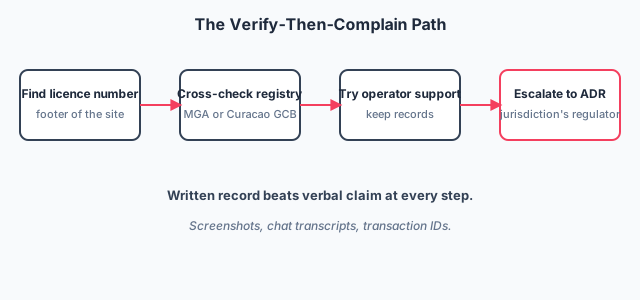
Escalate in this order. Every step is documented in writing. Screenshots and reference numbers are the currency of a complaint file.
- Open a support ticket with the operator's front-line team. Log the ticket number.
- Escalate to the operator's compliance or player-protection team via the email in the terms.
- File with the licensing regulator's player complaint route — MGA player support or GCB portal.
- Where an approved ADR body applies (standard for MGA), file with the ADR. Decisions bind the operator.
- Contact your Australian bank about a possible chargeback if a payment step was mishandled and is inside the chargeback window.
Two things not to do. Do not post confidential account details publicly while a case is active — it complicates rather than accelerates resolution. Do not close the account before the withdrawal is settled — closed accounts are harder to reopen for follow-up. Our new online casino australia coverage tracks how dispute resolution routes are evolving for reformed Curacao licensees.
Frequently Asked Questions
Is an offshore casino illegal for Australian players?
For the player, no. The IGA 2001 criminalises supply of the service to Australia, not the individual's use of it. The offshore operator is targeted; the household is not.
Who oversees offshore online casino australia operators?
The regulator that issued the licence — MGA in Malta, GCB in Curacao, or the equivalent in Costa Rica or Panama. ACMA has no direct oversight of the offshore operator; it acts against sites in Australia through blocking orders.
What currencies do Australian-facing casinos accept?
AUD is common at operators that market to Australian traffic. EUR and USD are standard defaults on operators that accept Australian residents without formally marketing to them.
What languages are typically supported?
English is universal. Multi-language operators typically add European languages first — Spanish, German, Italian, French, Portuguese — and increasingly add Japanese, Korean and Portuguese variants for other markets.
How fast are withdrawals in practice?
E-wallets clear within a business day at well-run operators once KYC is complete. Bank transfers run five to ten business days end to end. Crypto rails are near-instant on the operator side; on-chain confirmation is separate.
What do bonus terms typically look like?
Match bonuses of 100 to 200 per cent are common, with wagering requirements of 30 to 60 times the bonus (sometimes deposit plus bonus). Game weightings matter — pokies count 100 per cent while table games often count 10 per cent or zero.
Where do I escalate an unpaid withdrawal?
Start with operator support and log everything. Escalate to the licensing regulator's player complaint route. Where an approved ADR is in scope, that decision is binding on the operator.
Responsible Gambling
Set deposit limits. Set session limits. Stop when the money runs out for the session, not when the balance runs out. Never gamble to solve a financial problem — that reliably makes it worse. If a friend, partner or family member has raised a concern about your play, that is the signal to talk to someone independent rather than argue about whether they are right.
National support is confidential and free. Gamblers Help is state-based; GambleAware is national; Lifeline is 24/7 on 13 11 14. The BetStop self-exclusion register is available for the domestic-licensed market, and the Interactive Gambling Act 2001 is the statute that sits behind everything on this page.